Guides
The cost of nail salon equipment, new and second-hand
New versus second-hand nail salon equipment comes down to cost of ownership, not sticker price. Here are real figures by item and the arithmetic to compare them.
What to take away
- The cost of nail salon equipment, new and second-hand, starts with a new manicure table from Collins, Belvedere or Gamma at about $300 to $900. A used one runs $80 to $300, and the surface refinishes.
- A new curing lamp from Gelish, OPI or CND runs $150 to $500. A used lamp is the worst buy on this list, because output drops with use and you cannot see it.
- A new pedicure unit from Continuum, MTI or Living Earth Crafts runs $1,200 to $3,500. Used units sell for $300 to $900, and the cheap ones are cheap for a reason you find out later.
- Compare cost of ownership over a holding period, not sticker price. Consumables and downtime are two of the largest terms, and neither appears on a price tag.
- Buy newmetal implements, files, buffers, anything porous. These cannot be verified for prior handling.
The formula to compare on
Fill this with your own figures over a holding period of N years.
TCO formula terms
- P_buypurchase, delivery, installation
- C_consumableannual filters and parts
- C_serviceannual servicing and repair
- C_downtimerevenue lost while out of action
TCO = P_buy + (C_consumable x N) + (C_service x N) + C_downtime - V_resale
P_buyis the purchase price plus delivery and installation.C_consumableis the annual cost of filters, parts and anything the unit eats.C_serviceis expected annual servicing and repair.C_downtimeis revenue lost while the item is out of action.V_resaleis what it is worth at the end ofN.
Three terms behave differently on used equipment. C_service is higher and less predictable, because you did not see the first owner's duty cycle.
C_downtime is higher: parts for an older model arrive slowly, and there is usually no warranty path. V_resale is often close to what you paid, which is what makes used equipment attractive when the first two behave.
Run the formula twice, once for new and once for used, on the same N. If the gap is smaller than the uncertainty in C_service, the decision is not really about money.
The matrix by item type
| Item | New price | Used price | Reasonable used | Why | What to check first |
|---|---|---|---|---|---|
| Manicure tables and cabinetry (Collins, Belvedere, Gamma) | $300 to $900 | $80 to $300 | Usually yes | Little to wear out, and surfaces can be refinished | That extraction is fitted correctly or can be |
| Technician and client seating (Collins, Belvedere, Pibbs) | $150 to $600 | $50 to $250 | Sometimes | Gas lifts and foam wear invisibly | Adjustment range, gas lift replaceable, no soft spots |
| Curing lamps (Gelish, OPI, CND) | $150 to $500 | $40 to $150 | Rarely | Output declines with use and cannot be judged by eye | Whether the maker specifies it for your gel and states service life |
| Extraction units (Aerovex, Purex) | $400 to $1,500 | $150 to $600 | Cautiously | Motor and housing wear; filters may be superseded | That filters are still supplied and the stages match your needs |
| Pedicure units (Continuum, MTI, Living Earth Crafts) | $1,200 to $3,500 | $300 to $900 | Cautiously and never blind | Internal water paths are the whole risk | Piped or pipeless, and whether a cleaning procedure is still published |
| Metal implements (Tweezerman, Kupa) | $3 to $40 each | Do not buy | No | Cannot be verified for prior handling | Nothing; buy these new |
| Front desk and retail fixtures (Collins, Belvedere) | $200 to $1,200 | $50 to $400 | Yes | No operational risk at all | Only that they fit |
| Autoclave or sterilizing equipment (Tuttnauer, Midmark, Pelton & Crane) | $500 to $2,500 | $200 to $800 | Only with records | Function has to be demonstrable | Service history and whether your board accepts the model |
Named examples sit in those bands. Gelish 18G and OPI LED Light lamps typically list new between $150 and $300. Budget MelodySusie and Sunuv lamps often sell under $80 new. Collins and Belvedere manicure tables usually list between $300 and $900 new.
New vs used by item
Item
- Manicure tables
- $300-900
- Seating
- $150-600
- Curing lamps
- $150-500
- Extraction units
- $400-1,500
- Pedicure units
- $1,200-3,500
- Metal implements
- $3-40 each
- Front desk
- $200-1,200
- Autoclave
- $500-2,500
New price
- Manicure tables
- $80-300
- Seating
- $50-250
- Curing lamps
- $40-150
- Extraction units
- $150-600
- Pedicure units
- $300-900
- Metal implements
- Do not buy
- Front desk
- $50-400
- Autoclave
- $200-800
Used price
- Manicure tables
- Usually yes
- Seating
- Sometimes
- Curing lamps
- Rarely
- Extraction units
- Cautiously
- Pedicure units
- Never blind
- Metal implements
- No
- Front desk
- Yes
- Autoclave
- Only with records
Verdict
- Manicure tables
- Seating
- Curing lamps
- Extraction units
- Pedicure units
- Metal implements
- Front desk
- Autoclave
Aerovex extraction units commonly sell from $400 to $1,500 new. Tuttnauer and Midmark tabletop autoclaves often fall in the $500 to $2,500 new band. Continuum and MTI pedicure spas commonly list from $1,200 to $3,500 new. Kupa and Tweezerman implements cost $3 to $40 each and should be bought new.
Prices are typical US ranges for 2026 and vary by brand, size and region. Check current quotes from your supplier before budgeting.
Read the lamp and pedicure rows twice. An aged lamp under-cures, which shows up as peeling blamed on technicians for months. A pedicure unit with no available cleaning procedure cannot be made compliant by good intentions. What each item has to make possible is set out in the nail salon equipment and setup guide.
Buying from a closing salon
Ask for the model and serial number of every item before agreeing a price, then check with the manufacturer whether parts and consumables are still supplied. For a Gelish or OPI lamp, ask for the hour count.
For a Tuttnauer or Midmark autoclave, ask for the last spore test. For an Aerovex extraction unit, ask for filter part numbers. Ask why the salon is closing, because the answer sometimes explains the condition of the equipment. Treat missing service records as a price factor rather than as a detail.
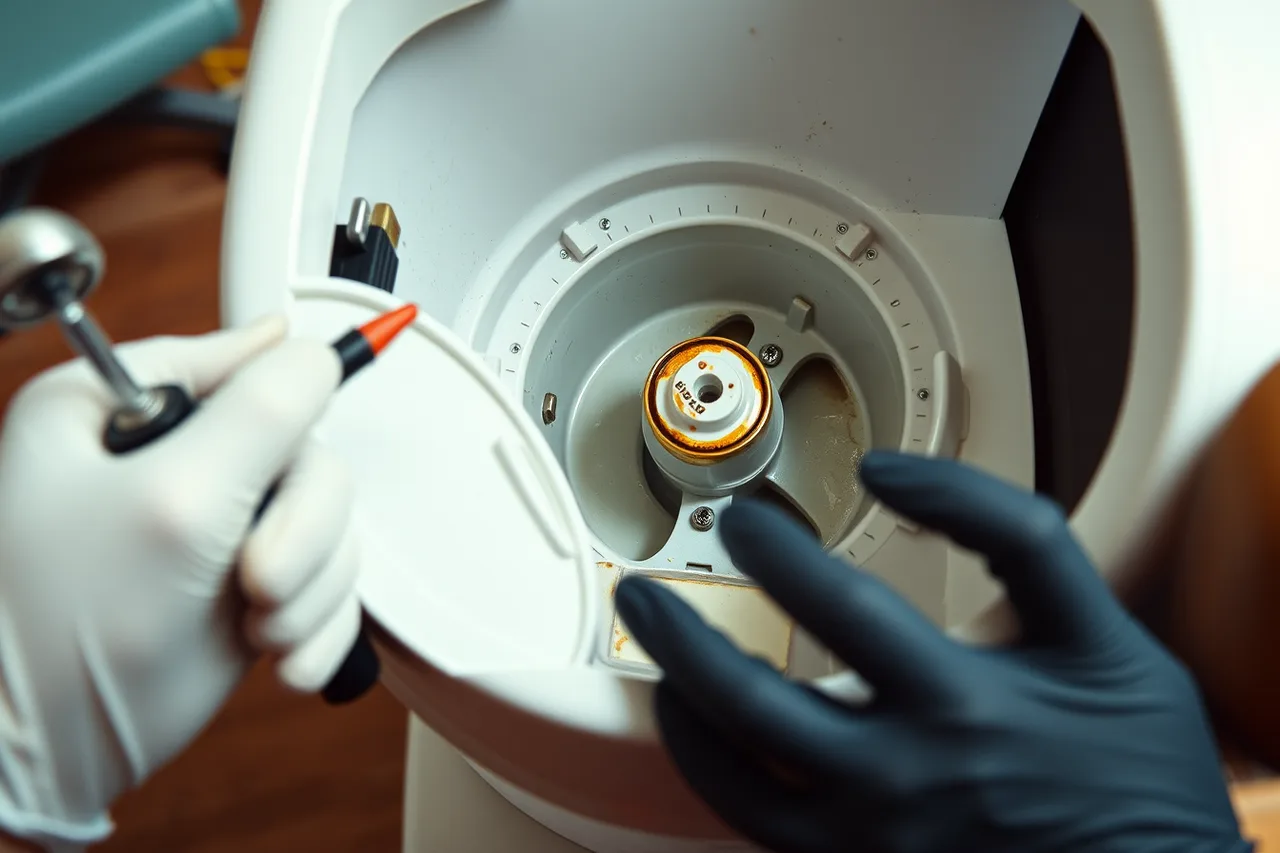
Look at the pedicure units with the impeller or pump cover off, not from across the room. Check the extraction filters; one that was clearly never changed shows what the rest of the maintenance was like.
Ask which disinfectant was in use and check its registration against the EPA list of registered antimicrobial products. A unit cleaned with an unregistered product has a history you cannot audit.
Do not buy metal implements, files, buffers or any porous item. Confirm that anything you do buy is acceptable under your own state board's rules, since boards differ. The licensing and compliance guide maps who to ask.
Where the saving actually lands
Used equipment lowers P_buy, the term a new owner feels most, since it comes from a finite opening budget. It raises C_service and C_downtime, paid later from trading revenue.
Buy used or new
Short on opening capital and expecting revenue?
buy furniture and fixtures used
buy invisible-wear items new
That trade can be correct for a salon short on opening capital and expecting revenue. It usually is not for one that cannot afford an unpredictable outage in month three.
A mixed approach is normal. Buy Collins or Belvedere furniture and fixtures used. Buy Gelish, OPI or CND lamps and Kupa or Tweezerman implements new. Never economize on what makes a required sanitation procedure possible. What belongs in each zone is listed in the nail salon equipment checklist.
One term rarely appears in the comparison: equipment that is unpleasant to use drives staff turnover. Replacing a technician is expensive, as the nail salon hiring and training guide sets out.
A used chair bought cheap, then endured all day, is no saving. The employer duty for equipment and chemicals follows OSHA guidance on safety management, and second-hand equipment carries no lower duty.
Common questions
Is a refurbished unit the same as used?
Only if someone names what was refurbished and who did it. Ask for the work list. A refurbishment that means a clean and a new cover is a used unit with better photographs.
Should the whole fit-out be one or the other?
No. The matrix splits by item because the right answer differs by category, and a blanket policy overpays in one direction or takes risk in the other.
How do I value a used item fairly?
Work backwards from the formula. What you can pay is the new-equipment total cost of ownership minus your estimate of the used one's service, downtime and consumable costs over the same period.
What about leasing instead?
Leasing changes the shape of the cash flow rather than the operating question, and it usually comes with maintenance terms worth reading closely. Compare it as a third column using the same N.