Guides
Nail salon service packages: matching menus to how the day runs
A nail salon service menu should be built from real service times and product costs, with packages grouped by how often clients return for each service.
What to take away
- A menu is a chair schedule in disguise. Every package you add takes minutes from a technician and a slot from the book.
- Time each service with a stopwatch before you name it. Gel polish, builder gel and acrylic do not share a turnaround.
- Price from product cost per set plus minutes, not from what the salon down the street charges.
- Group services by how often the client returns. A fill at three weeks and a pedicure at six belong in different packages.
- Confirm disinfection and licensing rules with your state board before you write any package description.
Start with minutes, not names
Write down every service you already perform, then time it. Not the ideal time: the real one, from the client sitting down to the chair wiped and the table reset. A gel manicure, a builder gel overlay and a full acrylic set look similar on a menu and behave nothing alike in a book.
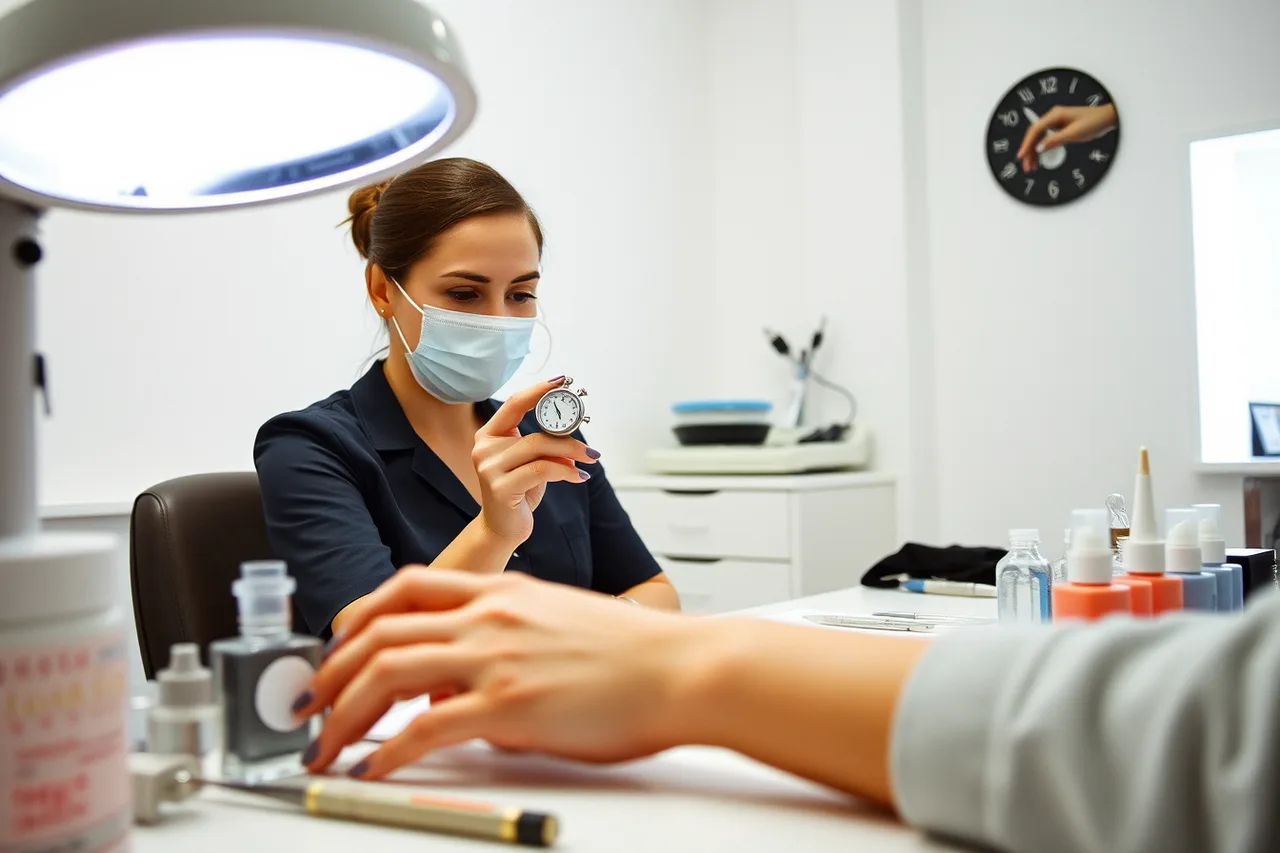
That number is your capacity: a technician's six-hour block holds four ninety-minute services, cleanup included. Add a fifth package to the menu and you have not added revenue. You have added a promise you cannot keep on a Saturday.
A service that holds the chair for ninety minutes is rated on minutes, product cost and rebooking rate, not on its menu price.
Group by return visit
| Group | Typical return | What it costs you |
|---|---|---|
| Natural nail care | Two to four weeks | Short chair time, low product cost |
| Gel polish | Two to three weeks | Removal time you must book, not squeeze |
| Builder gel or structured | Three to four weeks | Longer application, higher product cost |
| Acrylic full set and fills | Two to three weeks | Fills are the repeat revenue, sets are the entry |
| Pedicure | Four to six weeks | Basin, longer block, cleaning between clients |
Read the table as a scheduling document. Two short-return services on one client means she is in your chair twice as often as a pedicure client, and each visit needs its own slot. Rebooking intervals decide how many slots each client takes, and a booking grid built on real turnaround keeps those returns from colliding.
Return intervals by service group
Natural nail
- Typical return
- 2-4 weeks
- Chair time
- Short
- Product cost
- Low
Gel polish
- Typical return
- 2-3 weeks
- Chair time
- Removal must be booked
- Product cost
- Moderate
Builder gel
- Typical return
- 3-4 weeks
- Chair time
- Longer application
- Product cost
- Higher
Acrylic
- Typical return
- 2-3 weeks
- Chair time
- Fills repeat
- Product cost
- Higher
The three tiers most salons can run
Most menus collapse into three workable tiers once you stop naming them after price.
What it covers
- Express
- Natural nail care: shape, cuticle work, buff, polish or none
- Standard
- Gel polish over the natural nail, plus prep, adhesion and a cure
- Premium
- Builder gel or structured manicure, with more filing and structure
Removal
- Express
- Polish removal only
- Standard
- Soak-off, booked as its own block
- Premium
- File-off
Soak-off, file-off and full removal are different jobs with different minutes. Every tier states its removal step and its exclusions.
Clients assume a package covers art, shape changes and repairs unless the menu says otherwise.
Rebooking interval belongs on the menu. It is the clearest signal of what a service is.
Price from your own numbers
Set a product cost per service, call it P, and add the minutes it takes, call that M.
Multiply M by your loaded hourly cost per technician: wage, payroll burden, and the chair's share of rent and utilities, and call that L. Your floor price is P + (M x L); anything below it loses money on every booking.
Then decide what the package includes. A removal is labor and product, so it belongs in the price of the service that follows, not in a free add-on. Retail attachment goes on top, and it is the one line where the client chooses to spend more rather than you choosing to earn less.
Worked example for the standard tier. Replace these numbers with your own. Gel polish books 75 minutes with soak-off and dry time. Product cost is $6, the technician costs $22 an hour loaded, and you want a 60 percent margin. Price = (75 / 60 x 22 + 6) / (1 - 0.60), which is $83.75.
Where the tiers break
A package can eat two slots to fill one. If a tier needs ninety minutes of chair time and fifteen minutes of setup, it blocks two bookings and pays for one. Count how often it runs past its slot over twenty appointments.
- Removal booked as an add-on pushes the next client late. Book removal as its own line with its own minutes.
Rank tiers by contribution per chair hour, not by total revenue. The highest figure is the tier to promote, staff and train for. Redo the ranking quarterly as product cost moves.
Write the menu so staff can use it
A package description should say four things: what the client gets, how long it takes, what it costs, and when to rebook. Anything else is decoration. If a technician cannot read a package and know whether to book sixty or ninety minutes, the menu is not finished.
Keep the descriptions truthful. Advertising claims must be supported, and the FTC advertising guide for small business covers what that means for package names and any results you imply. Keep the underlying tickets and product invoices in a form that satisfies IRS recordkeeping guidance, because your pricing floor is only as good as the cost numbers behind it.
The BLS occupational outlook for manicurists and pedicurists lists several duties. These include consultation, shaping, product application and sanitation. They also include scheduling and retail. This is a fair outline of what a package must account for.
Where clients ask for something you do not offer
Say no, or refer out. If a client has a nail or skin condition, the salon records what was observed, declines the service, and refers her to a physician or podiatrist. Nothing in the menu treats it.
The same applies to a service you have not trained for. A package you cannot perform to standard is a complaint, a redo, and unpaid chair time.
Build the menu from the nail salon services and packages guide only after you have timed your own list. Then use the packaging method for client-facing menus to decide what sits together.
Common questions
How many packages should a small salon run?
Fewer than you think. Six to ten covers most walk-in and booked demand without forcing staff to memorize exceptions. Add one only when clients already ask for it.
Should removal be included in a gel or acrylic package?
Price it in or list it separately, but never leave it unbilled. Removal is chair time and product, and it is the step that gets rushed when it is free.
How often should the menu be reviewed?
Once a quarter, or whenever product cost or your loaded hourly cost moves. Recheck the time each service actually takes, since that drifts as technicians get faster or slower.